

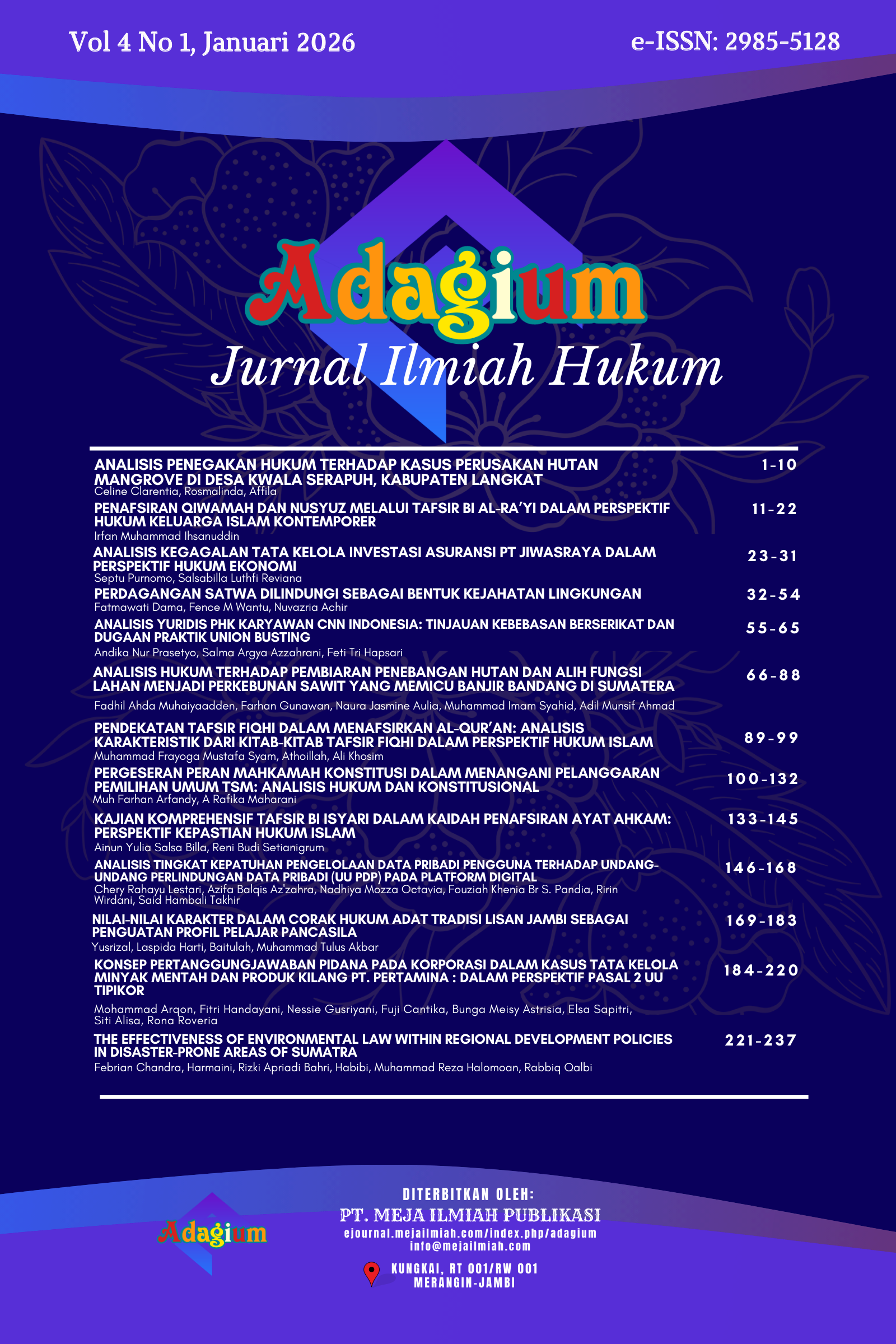
A Comprehensive Study of Tafsir bi al-Isyari in the Methodology of Ayat Ahkam Interpretation: An Islamic Legal Certainty Perspective
Article Sidebar
Main Article Content
Abstract
Tafsir bi Isyari is a method of interpreting the Qur'an that emphasizes the inner meaning (batin) and hidden meaning, which differs from the outer meaning (zahir) that is textual. This method is grounded in Hadith (Prophetic tradition) which states that the Qur'an possesses both an outer and inner meaning, and is revealed based on special guidance and inspiration for its experts. This paper comprehensively examines the definition of Tafsir Isyari, the different views of scholars regarding the legality and conditions for accepting Tafsir Isyari, as well as its strengths and weaknesses. The research also presents concrete examples of Qur'anic verses that command in an isyari (allusive/allusional) manner as a form of application of this method. The results of the study indicate that Tafsir Isyari can provide a deep and spiritual understanding, but it must be kept within the principles of Tafsir (exegesis) so that it does not lead to subjectivity and deviation. Therefore, this interpretation holds an important position in the treasury of Tafsir, provided that it is carried out in accordance with scholarly and Sharia principles.
Article Details
Section

This work is licensed under a Creative Commons Attribution-ShareAlike 4.0 International License.
How to Cite
References
Muhammad bin Ibraheem al-Shanqeeti, Usul al-Tafsir (Kairo: Dar al-Salam, 1995).
A.R.P. Putri dan M.F.L.D. Muttaqin, “Mengulik Sejarah Perkembangan Tafsir Isyari dan Pandangan Para Ulama,” AR-ROSYAD Jurnal Keislaman dan Sosial Humaniora 22 (2024).
HR. Muslim, no. 1773, Kitab al-Tafsir.
Badruddin Muhammad ibn Abdullah az-Zarkasyi, Al-Burhan fi Ulum al-Qur’an, Juz 1 (Beirut: Dar al-Ma’rifah, 1983).
Muhammad Amin Suma, Studi Ilmu-Ilmu al-Qur’an (Jakarta: Pustaka Firdaus, 2001).
HR. Muslim, Kitab al-Tafsir.
Ibnu Arabi, Al-Futuhat al-Makkiyah, Jilid 2 (Beirut: Dar al-Kutub al-Ilmiyyah, 2003), hlm. 107-110; az-Zarkasyi, Al-Burhan.
A.U. Hidayatullah, “Makalah Ilmu Tafsir: Klasifikasi Tafsir Berdasarkan Sumber II,” makalah (2025).
N. Mahrani, “Tafsir al-Isyari,” Hikmah 141 (2017).
S. Maryana, “Tafsir bi Ra'yi di Era Klasik dan Modern,” Al-Muhith (2025).
Muhammad Sofyan, Tafsir wal Mufassirun (Bandung: Perdana Mulya Sarana, t.th.).
Muhammad bin Ali asy-Syaukani, Fath al-Qadir (Beirut: Dar al-Ma’rifah, 1994).
T. Rahayu, “Perspektif Tafsir Bi Al-Ma'tsur, Bi Ar-Ra'yi, dan Bi Al-Isyari,” (2024), diakses dari jurnal Yayasan Pendidikan Dzurriyatul Quran.
A.U. Hidayatullah, “Makalah Ilmu Tafsir,” 2025.
Muhyiddin Ibnu Arabi, al-Futuḥāt al-Makkiyyah (Beirut: Dar al-Kutub al-‘Ilmiyyah, t.th.), jilid 1
Putri dan Muttaqin, “Mengulik Sejarah Perkembangan Tafsir Isyari dan Pandangan Para Ulama,” AR-ROSYAD 22 (2024).
Hidayatullah, A. U. PENJELASAN MENEGENAI TAFSIR BIL RA’YI DAN TAFSIR BIL ISY’ARI.
H. Husin Abdul Wahab, Kontroversi terhadap eksistensi Tafsir Isyari. November 2020.
Mahrani, N. (2017). Tafsir al-isyari. Hikmah, 14(1).